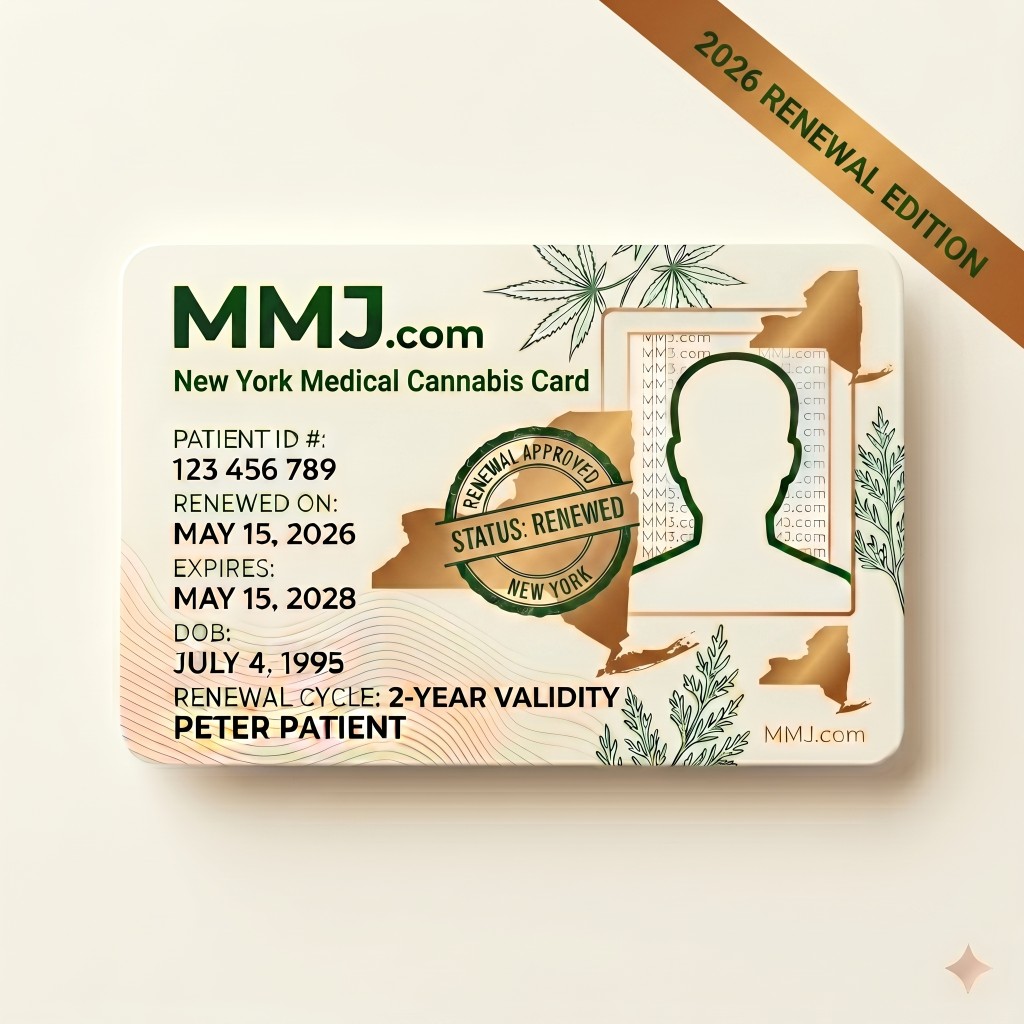
New York MMJ Card Renewal: Complete Guide
Why Renew Your New York Medical Cannabis Patient Certification in 2026?
New York operates a fully dual market under the Marijuana Regulation and Taxation Act (MRTA, signed March 31, 2021), which created the Office of Cannabis Management (OCM) and consolidated the original 2014 Compassionate Care Act medical cannabis program into the unified NY Cannabis Law framework. The OCM administers both the medical cannabis program (NY Cannabis Law § 30 et seq.) and the adult-use market, with adult-use retail launched December 29, 2022 under MRTA. With both markets fully operational, the renewal decision now hinges on the substantial medical-vs-adult-use tax differential and several patient-only privileges that adult-use buyers do not receive. The February 19, 2026 amendments (Senate Bill 3294-A) made the medical program even simpler: certifications are now valid for 2 years under NY Cannabis Law § 30(6), and there is no separate patient registration step: OCM's guidance is that patients present the certification (paper or on a phone) with a government-issued photo ID at any licensed New York medical dispensary.
Letting your practitioner certification lapse means losing the 0 percent medical-tier sales tax at the register and reverting to the combined 13 percent adult-use rate (9 percent state cannabis excise + 4 percent local cannabis excise) at every OCM-licensed dispensary. That is a 13-percentage-point swing on every purchase, plus the loss of the medical supply purchase limit and the 18-plus medical access age (vs. 21-plus recreational). Renewing on time preserves all of these benefits without a lapse in dispensary access, and because New York charges no state patient fee, the renewal cost is just the $149.99 MMJ.com video evaluation, needed only once every 2 years for most patients.
New York Medical Cannabis Renewal: Quick Facts
- Regulator: New York Office of Cannabis Management (OCM); program transferred from NYSDOH to OCM under MRTA in 2021
- Patient portal: cannabis.ny.gov via my.ny.gov / NY.gov ID account
- Statute (program): NY Cannabis Law § 30 et seq. (Medical Cannabis Program, established by MRTA, signed March 31, 2021)
- Statute (qualifying conditions): NY Cannabis Law § 30 (broad open-framework qualifying-condition standard: any condition for which a New York-registered practitioner determines medical cannabis is appropriate)
- Statute (practitioner certification): NY Cannabis Law § 30 (practitioner certifies patient)
- Statute (certification validity): NY Cannabis Law § 30(6), as amended by Senate Bill 3294-A effective February 19, 2026: a certification expires 2 years after the date the practitioner signs it, unless the practitioner sets an earlier date
- Patient registration: Automatic upon certification; the OCM no longer requires a separate patient registration step, and there is no state patient fee
- Statute (adult-use): NY Cannabis Law (MRTA, P.L. 2021); adult-use retail launched December 29, 2022
- Renewal cycle: Every 2 years (or by the earlier expiration date your practitioner sets)
- MMJ.com physician fee: $149.99 (renewal-priced video evaluation)
- State patient fee: $0 (New York charges no patient fee)
- Total renewal cost: $149.99 every 2 years for most patients (about $75 per year effective)
- Medical sales tax rate: 0% at the register
- Adult-use combined rate: 13% (9% state cannabis excise + 4% local cannabis excise)
- Medical possession limit: Up to a 60-day supply, or 3 ounces flower / 24 grams concentrate, whichever is greater (per the 2026 amendments)
- Adult-use possession limit: 3 ounces flower / 24 grams concentrate
- Medical access age: 18-plus (vs. 21-plus recreational)
- Telehealth allowed for renewals: Yes, audio-visual video evaluation
- Physical card: None (NY eliminated physical medical cannabis cards under MRTA)
- Out-of-state patients: NY Cannabis Law § 32-a (added by S3294-A) authorizes purchases by patients certified or registered in another U.S. jurisdiction once the Cannabis Control Board adopts implementing regulations; OCM lists this provision as requiring regulations, and the Part 113 amendments were only proposed on March 5, 2026
Your New York Medical Cannabis Renewal Process
The renewal is fully online for returning New York patients. Begin up to 60 days before your practitioner certification expires so dispensary access never lapses.
Step 1: Book Your Renewal Evaluation
Schedule a renewal-priced ($149.99) appointment with a New York-registered practitioner on MMJ.com. The HIPAA-compliant intake captures your existing OCM Patient Registry profile (your Patient Registration ID and the date your most recent practitioner certification expires), your originally-certified qualifying condition under NY Cannabis Law § 30, and a brief update on symptoms and treatment response since your last certification. Returning patients typically book and complete the visit on the same day.
Step 2: Complete the Secure Video Evaluation
Connect via audio-visual video telehealth for a 10 to 15 minute renewal evaluation with a New York-registered practitioner under NY Cannabis Law § 30. The practitioner verifies your qualifying condition is still present, reviews any treatment changes since the last certification, confirms continued clinical appropriateness of medical cannabis, and digitally signs the new certification. Under NY Cannabis Law § 30(6) as amended February 19, 2026, the new certification is valid for 2 years from the date it is signed, unless the practitioner determines an earlier expiration date is clinically appropriate. If you are clinically ineligible for any reason, MMJ.com refunds the $149.99 in full per the 100% money-back guarantee.
Step 3: Practitioner Files the Certification to the OCM Patient Registry
After the video visit, your New York-registered practitioner electronically files the digitally signed certification through the Health Commerce System (HCS) integrated with the Office of Cannabis Management (OCM) Medical Cannabis Patient Registry. New York is one of the few states where the patient does NOT have to upload the certification on a portal manually; the practitioner-side filing is built into the HCS Medical Cannabis system. You will receive an email confirmation from the OCM when the certification has been filed and posted to your patient profile, typically the same day or the next business day after the video visit.
Step 4: Confirm the Renewed Certification in the OCM Patient Registry
Log into the OCM Patient Registry at cannabis.ny.gov via your existing my.ny.gov / NY.gov ID account within 1 business day of the practitioner filing. Confirm the renewed certification is active and the new expiration date appears under your patient profile. Registration with the OCM is automatic when your practitioner certifies you; there is no separate registration renewal step and no state patient fee. New York eliminated physical medical cannabis cards as part of the MRTA-era simplification; your active certification plus a government-issued photo ID is what unlocks dispensary access.
Step 5: Shop at the 0% Medical-Tier Sales Tax Rate
Once the renewed certification is active in the OCM Patient Registry, shop at any NY OCM-licensed medical dispensary at the 0 percent medical-tier sales tax rate. Adult-use buyers pay the 13 percent combined cannabis excise rate (9 percent state cannabis excise + 4 percent local cannabis excise) at every OCM-licensed dispensary. Medical patients also retain the medical possession limit (up to a 60-day supply, or 3 ounces flower / 24 grams concentrate, whichever is greater) and the 18-plus medical access age.
Cost Breakdown: $149.99 Every 2 Years
| Component | Amount | Paid To |
|---|---|---|
| MMJ.com renewal video evaluation | $149.99 | MMJ.com |
| State patient fee | $0.00 | NY OCM |
| Physical card fee | N/A | (NY eliminated physical cards) |
| Total per 2-year renewal cycle | $149.99 |
New York charges no state patient fee, and registration with the OCM is automatic when your practitioner certifies you, so the only renewal cost is the practitioner evaluation. Because certifications are valid for 2 years under NY Cannabis Law § 30(6) (as amended February 19, 2026), the effective cost works out to about $75 per year, one of the lowest ongoing costs of any state medical cannabis program. New York also eliminated physical medical cannabis cards under the MRTA-era simplification: your active practitioner certification posted to your OCM patient profile plus a government-issued photo ID is what unlocks dispensary access; there is no $10 wallet card upgrade like New Jersey or Maryland offer.
Tax Math: Why the Renewal Pays for Itself
New York medical patients pay 0 percent sales tax at the dispensary register. Adult-use buyers pay the 13 percent combined cannabis excise rate (9 percent state cannabis excise + 4 percent local cannabis excise) at every OCM-licensed dispensary. That is a 13-percentage-point swing on every purchase. (New York does levy a 3.15 percent excise on medical cannabis gross receipts, but that tax is paid by the registered organization, not charged to you at the register.)
A patient spending $200 a month at the dispensary saves $26 a month or $312 annually vs. the adult-use rate. A patient spending $400 a month saves $52 a month or $624 annually. At $300 a month (a common monthly spend for chronic-pain or PTSD patients), the savings are $39 a month or $468 a year, more than 6 times the roughly $75-per-year effective cost of the 2-year renewal. New York is one of the most tax-favorable states for keeping an active medical certification because the 13 percent differential is unusually high (most adult-use states sit at the 6 to 10 percent combined range).
Patient-Only Privileges That Renewing Preserves
Beyond the tax differential, an active OCM Patient Certification preserves several rights that adult-use buyers do not receive:
- Larger possession limit: under the 2026 amendments, medical patients may possess up to a 60-day supply (as determined by the certifying practitioner), or up to 3 ounces of flower / 24 grams of concentrate, whichever is greater, vs. the flat 3-ounce / 24-gram adult-use limit.
- Medical access age: patients age 18 or older may register, while adult-use access is restricted to age 21 and older. This is the only legal pathway for 18-to-20-year-old patients with a qualifying condition.
- Practitioner-managed care continuity: the renewed certification keeps your qualifying condition documented in the OCM registry, which matters for product-formulation choice (concentrates, vapes, edibles, capsules, tinctures, lozenges, transdermals) and for the practitioner-recommended dosage guidance that adult-use buyers do not receive.
- Whole flower medical access since 2022: New York added whole flower (smokable) cannabis to the medical formulary in March 2021 (effective late 2021 / early 2022), bringing the medical product menu in line with the adult-use menu while preserving the 0 percent tax rate.
Common Renewal Mistakes (and How to Avoid Them)
- Letting the practitioner certification lapse before booking: book the MMJ.com video evaluation at least 30 days before your current certification expires. Once the certification expires, your OCM Patient Registry profile shows no active certification and you cannot make medical purchases until the new certification is filed by your practitioner.
- Assuming a separate OCM registration renewal is required: there is none. Your renewed certification, together with a government-issued photo ID, is what the dispensary verifies. The practitioner certification is the only renewal event; there is no separate registration to maintain in the portal.
- Using a non-NY-registered practitioner: NY Cannabis Law § 30 requires the certification be signed by a New York-registered practitioner (MD, DO, NP, PA, or other registered prescriber). MMJ.com routes New York patients only to practitioners actively registered with the OCM and licensed by the New York State Education Department / NYSDOH practitioner registry.
- Forgetting to confirm the certification was filed: check your email for the OCM confirmation that your new certification has been posted to your patient profile. If you do not see it within 1 to 2 business days of the video visit, contact your MMJ.com practitioner rather than waiting on the OCM.
- Looking for a physical card: New York eliminated physical medical cannabis cards under MRTA. Your active certification posted to your OCM patient profile plus a government-issued photo ID is what unlocks dispensary access; there is no wallet card to wait for.
Frequently Confused: New York vs. New Jersey Patient Registry
New York adults age 21 and older do not need an OCM certification to purchase cannabis at an OCM-licensed dispensary, just a valid government-issued photo ID. The OCM Patient Certification is what unlocks the 0 percent medical-tier sales tax, the 60-day supply purchase limit, and the 18-plus access age. If you are 21 or older and your only motivation is occasional purchasing, the adult-use market may be sufficient; if you purchase regularly, have a documented qualifying condition under NY Cannabis Law § 30, want practitioner-recommended dosage guidance, or are 18 to 20 years old with a qualifying condition, the renewal is almost always worth the $149.99 every-2-years cost.
Note that NY Cannabis Law § 32-a (added by S3294-A) will let out-of-state medical cannabis patients purchase from New York registered organizations with proof of home-state certification or registration plus a government-issued photo ID, but only once the Cannabis Control Board adopts the implementing regulations; OCM's summary marks § 32-a as requiring regulations, and the proposed Part 113 amendments were published for comment on March 5, 2026. Whether your New York certification is honored in another state depends entirely on that state's rules; New Jersey, for example, does not extend purchase privileges to visiting patients at its licensed Alternative Treatment Centers (ATCs). Patients who travel often should plan around the destination state's program rules.
Verified New York Renewal Resources
- New York Office of Cannabis Management (OCM) - the official OCM homepage covering both the medical cannabis program and the adult-use market under MRTA, with the patient portal sign-in via my.ny.gov / NY.gov ID.
- OCM Medical Cannabis Patient Registry - the patient-facing OCM page explaining that certified patients use the certification plus a government-issued photo ID at licensed dispensaries (no separate registration step).
- NY Cannabis Law § 30 et seq. (Medical Cannabis Program) - the statutory framework governing the medical cannabis program, the broad qualifying-condition standard under § 30, the 2-year certification validity under § 30(6), the practitioner certification rules under § 30, and the out-of-state patient reciprocity rules under § 32-a.
- Senate Bill 3294-A (2026 Medical Cannabis Amendments) - the legislation (signed November 21, 2025; most provisions effective February 19, 2026) that extended certification validity to 2 years, removed the registry-card requirement so the certification itself is the dispensary credential, and added § 32-a out-of-state patient reciprocity (pending regulations).
- Marijuana Regulation and Taxation Act (MRTA) - the 2021 legislation that established the OCM and the adult-use market, consolidating the original 2014 Compassionate Care Act medical cannabis program into the unified NY Cannabis Law.
Sources: New York Office of Cannabis Management, NY Cannabis Law § 30 et seq. (Medical Cannabis Program, established by MRTA, signed March 31, 2021), NY Cannabis Law § 30(6) as amended by Senate Bill 3294-A effective February 19, 2026 (2-year certification validity), NY Cannabis Law § 32-a (out-of-state patient reciprocity), and the OCM Medical Cannabis Patient Registry at cannabis.ny.gov.