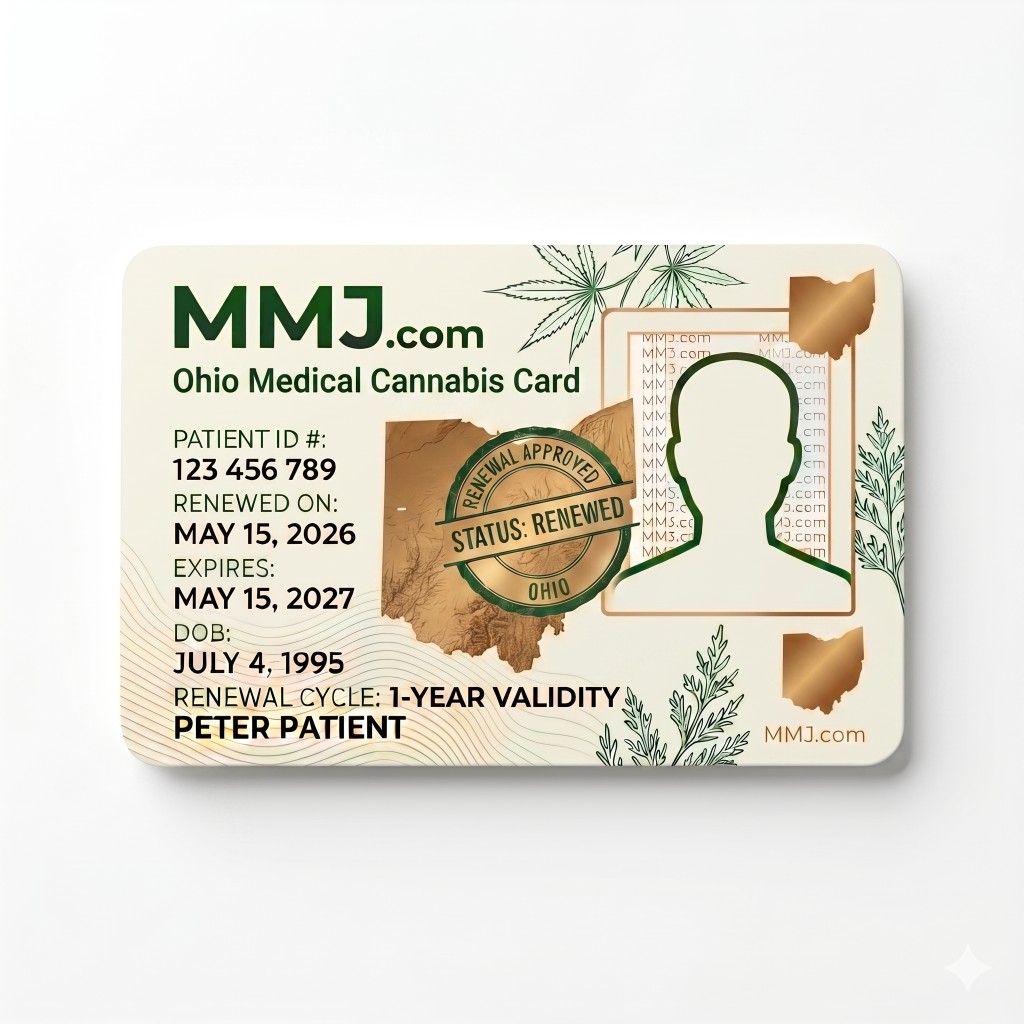
Ohio MMJ Card Renewal: Complete Guide
Why Renew Your Ohio Medical Marijuana Patient Registry Card in 2026?
Ohio operates a fully dual market under Ohio Revised Code Chapter 3796, the Marijuana Control Law. The medical program was originally enacted by HB 523 in 2016; the adult-use program (codified from Issue 2, ratified November 7, 2023, with retail sales beginning August 6, 2024) was consolidated into the same chapter by SB 56 (136th General Assembly, effective March 20, 2026), which repealed the separate adult-use Chapter 3780. Both programs are administered by the Division of Cannabis Control (DCC) within the Ohio Department of Commerce; patient and caregiver registration moved from the State Board of Pharmacy to the DCC in spring 2024 under HB 33 (135th General Assembly, the FY24-25 state budget). With both markets fully operational and 130 plus DCC-licensed dispensaries statewide, the renewal decision now hinges on the substantial medical-vs-adult-use tax differential and several patient-only privileges that adult-use buyers do not receive.
Letting your 1-year Patient Registry card lapse means losing the medical-tier tax exemption: medical patients are exempt from the 10 percent state cannabis excise tax under ORC Chapter 3796, while adult-use buyers pay the 10 percent state cannabis excise tax under ORC 3796.40 on top of the standard 5.75 percent state sales tax + local sales tax (typically 1 to 2.25 percent depending on county) that both medical and adult-use buyers pay. That is a 10-percentage-point swing on every purchase, plus the loss of the 90-day supply purchase model under OAC 4729-37 (vs. the 2.5-ounce flower / 15-gram extract per-transaction adult-use limit, recodified under Chapter 3796 by SB 56), and the 18-plus medical access age (vs. 21-plus recreational). Renewing on time preserves all of these benefits without a lapse in dispensary access, and because the DCC eliminated patient registry fees in May 2024, the renewal cost is just the $149.99 MMJ.com video evaluation.
Ohio Medical Marijuana Renewal: Quick Facts
- Regulator: Division of Cannabis Control (DCC) within the Ohio Department of Commerce; patient registry administration transferred from the State Board of Pharmacy in spring 2024 under HB 33 (135th General Assembly)
- Patient portal: patientregistry.ohio.gov (Ohio Patient and Caregiver Registry)
- Statute (medical program): Ohio Revised Code Chapter 3796 (Medical Marijuana Control Program; HB 523, 2016)
- Statute (qualifying conditions): ORC 3796.01 (25-condition list including PTSD, chronic pain, cancer, fibromyalgia, glaucoma, HIV / AIDS, MS, ALS, Parkinson's disease, sickle cell anemia, ulcerative colitis, Crohn's disease, terminal illness, and others)
- Statute (telemedicine standard): Ohio Administrative Code 4731-22-04 (State Medical Board of Ohio telemedicine standards)
- Statute (patient registry rules): OAC 4729-37 (90-day supply purchase model)
- Statute (adult-use): consolidated into Ohio Revised Code Chapter 3796 by SB 56 (136th General Assembly, effective March 20, 2026); originally Chapter 3780 (Issue 2, ratified November 7, 2023; retail sales began August 6, 2024)
- Fee elimination: Division of Cannabis Control administrative action effective May 15, 2024 (previously $50 patient / $25 caregiver)
- Card validity: 1 year from issue date
- MMJ.com physician fee: $149.99 (renewal-priced video evaluation)
- DCC patient registration fee: $0 (eliminated by the DCC in May 2024)
- Total annual renewal cost: $149.99
- Medical excise tax rate: 0% (exempt from the 10% state cannabis excise tax under ORC Chapter 3796)
- Adult-use excise tax rate: 10% state cannabis excise (ORC 3796.40)
- Standard state sales tax: 5.75% (paid by both medical and adult-use buyers)
- Local sales tax: Typically 1% to 2.25% (county-level; paid by both medical and adult-use buyers)
- Medical purchase limit: 90-day supply per OAC 4729-37 (Tier I and Tier II products)
- Adult-use possession limit: 2.5 ounces flower / 15 grams extract per transaction (recodified under Chapter 3796 by SB 56)
- Medical access age: 18-plus (vs. 21-plus recreational)
- Telehealth allowed for renewals: Yes, audio-visual video evaluation under OAC 4731-22-04
- Physician requirement: Active Certificate to Recommend (CTR) issued by the State Medical Board of Ohio (separate license from standard Ohio medical license)
- Licensed dispensaries: 130+ statewide
Your Ohio Medical Marijuana Renewal Process
The renewal is fully online for returning Ohio patients. Begin up to 60 days before your 1-year Patient Registry card expires so dispensary access never lapses; note that the DCC registry itself accepts the renewal submission only within the final 30 calendar days before expiration (OAC 1301:18-10-01(H)(3)), so the early booking is for the physician visit, not the portal step.
Step 1: Book Your Renewal Evaluation
Schedule a renewal-priced ($149.99) appointment on MMJ.com with an Ohio physician holding an active Certificate to Recommend (CTR) issued by the State Medical Board of Ohio under ORC Chapter 3796. The HIPAA-compliant intake captures your existing Ohio Patient and Caregiver Registry profile (your Patient ID and the date your 1-year Patient Registry card expires), your originally-certified qualifying condition under ORC 3796.01, and a brief update on symptoms and treatment response since your last certification. Returning patients typically book and complete the visit on the same day.
Step 2: Complete the Secure Video Evaluation
Connect via audio-visual video telehealth for a 10 to 15 minute renewal evaluation under Ohio Administrative Code 4731-22-04 (the State Medical Board of Ohio telemedicine standards). The CTR-licensed physician verifies your qualifying condition is still present, reviews any treatment changes since the last certification, confirms continued clinical appropriateness of medical cannabis, and digitally signs the new recommendation. Ohio requires the certifying physician to hold an active CTR specifically (separate from the standard Ohio medical license); MMJ.com routes Ohio renewals only to CTR-licensed physicians actively listed on the State Medical Board of Ohio CTR registry. If you are clinically ineligible for any reason, MMJ.com refunds the $149.99 in full per the 100% money-back guarantee.
Step 3: Physician Files the Recommendation to the DCC Patient Registry
After the video visit, your CTR-licensed physician electronically files the digitally signed recommendation through the Ohio Patient and Caregiver Registry portal at patientregistry.ohio.gov. The portal is administered by the Division of Cannabis Control (DCC) within the Ohio Department of Commerce, which took over patient registry administration from the State Board of Pharmacy in spring 2024 under HB 33 (135th General Assembly). Ohio is one of the few states where the patient does NOT have to upload the recommendation on a portal manually; the physician-side filing is built into the registry system. You will receive an email confirmation from the DCC when the recommendation has been filed and the renewed Patient Registry card has been issued, typically the same day as the video visit.
Step 4: Confirm the Renewed Patient Registry Card in the DCC Portal
Log into the Ohio Patient and Caregiver Registry portal at patientregistry.ohio.gov within hours of the physician filing. Confirm the renewed Patient Registry card is active and the new 1-year expiration date appears under your patient profile. The DCC patient registration renewal is free (the DCC eliminated patient and caregiver registry fees effective May 15, 2024), so there is no state fee to pay at this step. The renewed digital Patient Registry card is sufficient for medical-tier purchases at any DCC-licensed Ohio dispensary; the physical card is mailed to your Ohio address on file shortly after, but the digital ID is what unlocks dispensary access.
Step 5: Shop at the 0% Medical-Tier Excise Rate
Once the renewed Patient Registry card is active, shop at any of the 130 plus DCC-licensed Ohio medical dispensaries at the 0 percent medical-tier excise rate (medical patients are exempt from the 10 percent state cannabis excise tax under ORC Chapter 3796). Both medical and adult-use buyers pay the standard 5.75 percent state sales tax + local sales tax, but only adult-use buyers pay the additional 10 percent state cannabis excise tax under ORC 3796.40. Medical patients also retain the 90-day supply purchase model under OAC 4729-37 and the 18-plus medical access age.
Cost Breakdown: $149.99 Total
| Component | Amount | Paid To |
|---|---|---|
| MMJ.com renewal video evaluation | $149.99 | MMJ.com |
| DCC Patient Registry renewal fee | $0.00 | (eliminated May 2024) |
| Physical card mailing | $0.00 | DCC (included) |
| Annual total | $149.99 |
The $0 DCC patient registration fee is the result of the Division of Cannabis Control eliminating patient and caregiver registry fees effective May 15, 2024 (originally $50 patient / $25 caregiver). Ohio is one of only a handful of states (alongside Connecticut, Louisiana, Minnesota, New Jersey, and New York) that charges no state-level patient registry fee. Both the digital Patient Registry card and the mailed physical card are included in the renewal at no extra cost.
Tax Math: Why the Renewal Pays for Itself
Ohio medical patients are exempt from the 10 percent state cannabis excise tax under ORC Chapter 3796. Adult-use buyers pay the 10 percent state cannabis excise tax under ORC 3796.40 on every dispensary purchase. Both medical and adult-use buyers pay the standard 5.75 percent state sales tax + local sales tax (typically 1 to 2.25 percent depending on county), but the differential at the register is the 10 percent state cannabis excise.
A patient spending $200 a month at the dispensary saves $20 a month or $240 annually vs. the adult-use rate. A patient spending $400 a month saves $40 a month or $480 annually. At $300 a month (a common monthly spend for chronic-pain or PTSD patients), the savings are $30 a month or $360 a year, more than 2 times the $149.99 annual renewal cost. Because the DCC charges $0 for the patient registration renewal, the entire savings goes directly to the patient with no offsetting state fee.
Patient-Only Privileges That Renewing Preserves
Beyond the tax differential, an active DCC Patient Registry card preserves several rights that adult-use buyers do not receive:
- 90-day supply purchase model (OAC 4729-37): medical patients can purchase up to a 90-day supply at any one time, with the maximum based on Tier I (lower-THC) and Tier II (higher-THC) product classifications and the certifying physician's recommendation. Adult-use Ohioans are limited to 2.5 ounces of flower or 15 grams of extract per transaction (recodified under Chapter 3796 by SB 56).
- Wider product menu access: the medical formulary covers tinctures, capsules, lotions, patches, edibles, vape oils, and flower, with product selection guided by the certifying physician's recommendation.
- Medical-only home delivery: SB 56 (136th General Assembly, effective March 20, 2026) authorizes home delivery for medical patients only.
- Medical access age: patients age 18 or older may register with parental / caregiver consent for minors and any qualifying-condition holder age 18+, while adult-use access is restricted to age 21 and older. This is the only legal pathway for 18-to-20-year-old patients with a qualifying condition under ORC 3796.01.
- Caregiver designation: medical patients may designate up to 2 caregivers under ORC 3796.06 to purchase on their behalf at DCC-licensed dispensaries. Adult-use does not have a caregiver-designation pathway.
- Physician-managed care continuity: the renewed CTR-issued recommendation keeps your qualifying condition documented in the DCC patient registry, which matters for product-selection guidance and for any future legislative changes to qualifying-condition rules or product categories.
Common Renewal Mistakes (and How to Avoid Them)
- Letting the Patient Registry card lapse before booking: book the MMJ.com video evaluation at least 30 days before your 1-year card expires. Once the card expires, your DCC patient registry profile shows no active recommendation and you cannot make medical purchases until the new recommendation is filed by your CTR-licensed physician. Ohio does not offer a grace period.
- Using a non-CTR-licensed physician: ORC Chapter 3796 requires the recommendation be signed by an Ohio physician holding an active Certificate to Recommend (CTR) from the State Medical Board of Ohio (separate license from the standard Ohio medical license). MMJ.com routes Ohio renewals only to CTR-licensed physicians actively listed on the State Medical Board CTR registry.
- Confusing the 5.75% sales tax with the 10% excise tax: both medical and adult-use buyers pay the 5.75% state sales tax + local sales tax. The medical-vs-adult-use differential is the 10% state cannabis excise tax under ORC 3796.40; medical patients are exempt from the excise but still pay standard sales tax. The savings are real, but framed accurately.
- Forgetting to confirm the recommendation was filed: check your email for the DCC confirmation that your new recommendation has been posted to your patient profile. If you do not see it within hours of the video visit, contact your MMJ.com physician rather than waiting on the DCC.
- Looking for the State Board of Pharmacy: Ohio transferred the patient registry administration from the State Board of Pharmacy to the Division of Cannabis Control (DCC) within the Department of Commerce in spring 2024 under HB 33 (135th General Assembly). The Pharmacy Board no longer administers the patient registry; all renewal-related correspondence comes from the DCC.
Frequently Confused: Ohio Medical vs. Adult-Use Access
Ohio adults age 21 and older do not need a DCC Patient Registry card to purchase cannabis at a DCC-licensed dispensary, just a valid government-issued photo ID. The Patient Registry card is what unlocks the medical-tier 0 percent state cannabis excise rate (vs. 10 percent adult-use), the 90-day supply purchase model, the caregiver-designation pathway, and the 18-plus access age. If you are 21 or older and your only motivation is occasional purchasing, the adult-use market may be sufficient; if you purchase regularly, have a documented qualifying condition under ORC 3796.01, want to designate a caregiver, or are 18 to 20 years old with a qualifying condition, the renewal is almost always worth the $149.99 annual cost.
Verified Ohio Renewal Resources
- Ohio Division of Cannabis Control (DCC) - the official DCC homepage within the Ohio Department of Commerce, with the patient registry portal sign-in, the renewal application instructions, and the licensed dispensary locator.
- Ohio Patient and Caregiver Registry - the patient-facing portal where the Patient Registry card is issued, where physician recommendations post to your patient profile, and where the 1-year renewal is administered.
- Ohio Revised Code Chapter 3796 (Medical Marijuana Control Program) - the statutory chapter governing the medical cannabis program, the qualifying-condition list under ORC 3796.01, and the medical-tier excise tax exemption.
- Senate Bill 56 (136th General Assembly) - the law (effective March 20, 2026) that repealed the separate adult-use Chapter 3780 and consolidated adult-use and medical marijuana regulation under Chapter 3796, including the 10 percent adult-use excise tax now codified at ORC 3796.40.
- Ohio Administrative Code 4731-22-04 (Telemedicine Standards) - the State Medical Board of Ohio telemedicine standards governing audio-visual video evaluations for medical cannabis recommendations.
Sources: Ohio Division of Cannabis Control, Ohio Revised Code Chapter 3796 (the Marijuana Control Law: medical program per HB 523 of 2016; adult-use consolidated by SB 56 of the 136th General Assembly, effective March 20, 2026, with the adult-use excise tax at ORC 3796.40), HB 33 (135th General Assembly, moving patient registry administration to the Division of Cannabis Control in spring 2024), the DCC's May 15, 2024 elimination of patient and caregiver registry fees, and Ohio Administrative Code 4731-22-04 (Medical Board telemedicine standards) and OAC 4729-37 (patient registry 90-day supply rules).